
The Gravity of Collaboration: How Social Architecture Shapes Breakthrough Ideas
Yaz Gilbert
11/6/20252 min read
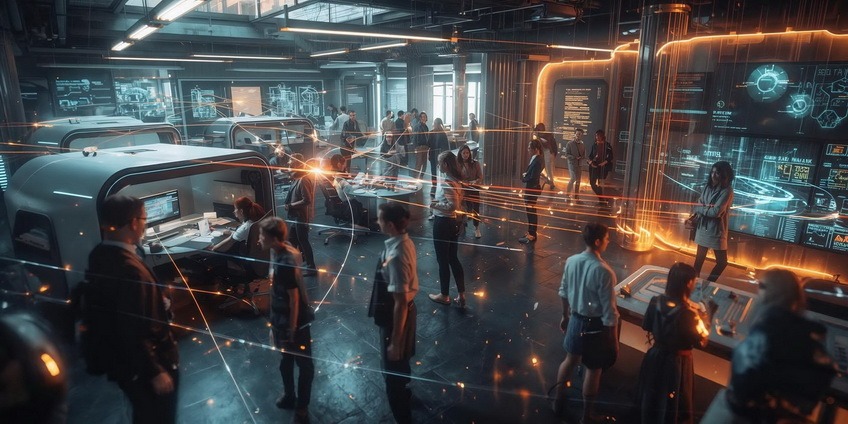

Innovation is often romanticized as the flash of genius—a Newtonian apple moment or Archimedes in his bathtub. But this narrative obscures a more powerful force: the invisible gravity of collaboration.
Breakthrough ideas are rarely solitary sparks—they are drawn into existence by social forces that pull disparate people, knowledge, and concepts together.
Research validates this principle. Sociologist Ronald Burt showed that individuals who bridge “structural holes” in networks access a wider diversity of perspectives, giving them a gravitational advantage.
The future of progress belongs to leaders who can design gravitational fields within their organizations, teams, and cities.
The Physics of Social Gravity
Collaborative potential is shaped by three elements: Mass, Distance, and Density.
1. Mass: The Weight of Knowledge and Diversity
Physics Principle: Gravity is proportional to mass.
Social Application: The more diverse the cognitive and experiential “mass” of a team, the stronger the innovative pull.
Common Error: Building teams of experts who all think alike → leads to groupthink.
Principle: Greater cognitive distance between disciplines increases innovative potential.
Application:
Map knowledge domains when forming teams.
Include individuals from unrelated fields as “gravitational lenses” to reframe problems.
Established Examples:
Tech: Apple Macintosh team—engineers, artists, poets, musicians—where technology and liberal arts intersected.
Non-Tech: The Fat Duck restaurant—Chef Heston Blumenthal recruited scientists, psychologists, and perfume experts to reinvent the dining experience.
2. Distance: The Friction of Proximity
Physics Principle: Gravity weakens with distance.
Social Application: Collaboration declines as physical, social, or hierarchical distance increases.
Common Error: Mistaking digital connectivity (Slack channels) for genuine proximity → creates isolated “islands” of expertise.
Principle: Reducing friction is critical. Spontaneous, low-stakes interactions are the lifeblood of innovation.
Application:
Physical Spaces: Design “intentional collisions” via shared coffee areas, printers, and restrooms.
Remote/Hybrid Teams: Create “virtual hallways” (persistent, low-pressure video rooms) to replicate water cooler moments.
Hierarchically: Flatten structures to create psychological safety for open idea sharing.
Established Examples:
Tech: Pixar campus—central atrium forces daily interactions across departments.
Non-Tech: VA Boston Healthcare System—interdisciplinary co-located teams and daily huddles reduced patient wait times.
3. Density: The Critical Mass of Interaction
Physics Principle: Gravity is stronger in dense clusters.
Social Application: High-frequency, high-quality interactions create powerful “gravitational fields” for ideas.
Common Error: Prioritizing deep work → creates interaction deserts.
Principle: Breakthroughs occur at critical mass of trust and shared understanding.
Application:
Co-located Teams: War rooms for side-by-side collaboration.
Remote Teams: Show-and-tell sessions or virtual co-working sessions to increase idea collisions.
Established Examples:
Tech: MIT’s Building 20—a dense, interdisciplinary hub that produced breakthroughs in radar and cognitive science.
Non-Tech: Toyota Production System—Andon cord enables high-density, real-time problem-solving interactions.
Summary Table: Physics of Collaboration
Physics ConceptCollaborative PrinciplePractical ApplicationEstablished ExampleMassCombine diverse knowledgeRecruit for “cognitive mass”Macintosh team included artists & poetsDistanceReduce friction (physical, social, digital)Intentional collisions & virtual hallwaysPixar campus fosters daily interactionsDensityHigh frequency of interactionsWar rooms & virtual co-workingMIT’s Building 20
The Social Architect’s Toolkit: Designing for Gravity
Proximity Map: Visualize communication flows to identify “dead zones” → take targeted action to bridge gaps.
Diversity Audit: Measure cognitive diversity → strategically inject diverse perspectives.
Friction Log: Identify process, software, or social friction → systematically remove “anti-gravity” points.
Designing Gravity in a Global, Hybrid World
Mass: Leverage diverse cultural and professional perspectives; activate mass through intentional forums.
Digital Distance: Use asynchronous channels, shared whiteboards (Miro), or “random discoveries” Slack channels.
Asynchronous Density: High contribution density via established communication rhythms, even when not everyone is online simultaneously.
Source: Haas & Mortensen, Harvard Business Review (2016), The Secrets of Great Teamwork.
Conclusion: From Org Chart to Gravitational Field
The old way of organizing was mechanical. The new way is physical—designing environments that pull ideas into existence.
Social Architects:
Study Proximity Maps
Hire for cognitive mass
Design for interaction density
Eliminate friction
When executed effectively, organizations don’t just chase breakthroughs—they attract them.