
The Cognitive Symbiosis Mindset: Thriving in the Age of AI
Yaz Gilbert
11/9/20254 min read
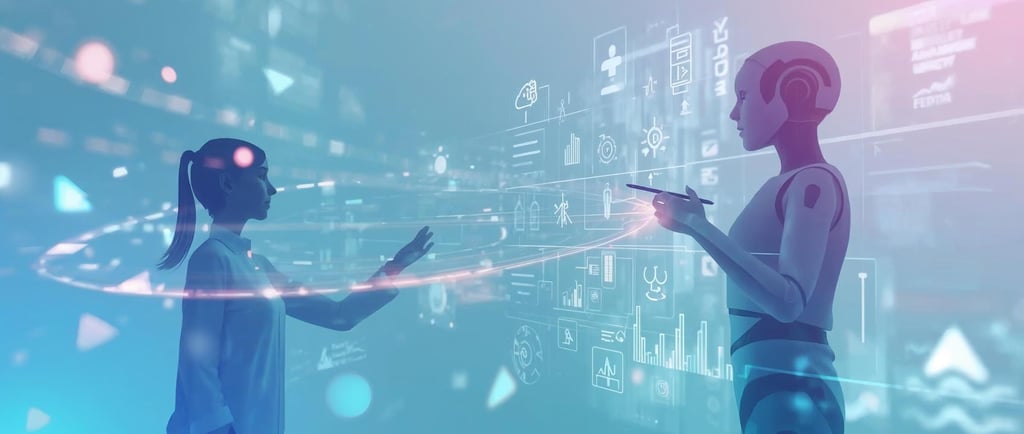

We're asking the wrong question about AI. We're obsessed with:
"Will AI take my job?"
This frames AI as a rival. It’s a question born of fear.
The more urgent question is:
"How can I partner with AI to amplify my humanity?"
This reframes everything. AI isn't a rival. Think of it as a cognitive exoskeleton—a lever for your mind. It can augment your intelligence, creativity, and empathy. But this partnership doesn't happen automatically. It requires a new mindset. A move from being a passive consumer to an active partner. This is the Cognitive Symbiosis Mindset.
This mindset is the core strategic competency for the 21st century. It's built on three fundamental shifts.
"In a world where answers are cheap, the real value is in asking the right questions."
The Cognitive Symbiosis Cycle
(Visual: A simple circular diagram with three interconnected nodes and arrows showing a continuous loop.)
YOU FRAME THE PROBLEM: You define the challenge, the context, and the goals.
AI GENERATES OPTIONS: The AI provides drafts, data, and diverse perspectives based on your frame.
YOU SYNTHESIZE & APPLY: You apply your unique human judgment, ethics, and experience to create the final outcome, which then informs your next problem frame.
Shift 1: From Consumer to Collaborator
The default mode is to be a consumer. We type a query, we get an answer. We treat AI like a vending machine for content. This is limited.
The Collaborator mindset treats AI as a partner. You're not just a prompter. You're a creative director working with a brilliant but context-free intern.
Example:
Consumer Asks: "Write me a marketing email."
Collaborator Says: "Let's work on this together. Your role is to generate five subject lines based on urgency. My role is to provide the value prop. Let's start with your lines."
This transforms the interaction from a transaction to a dialogue. You're not just consuming the AI's work; you're co-creating it. You're no longer just ordering off the menu; you're in the kitchen with the chef.
Shift 2: From Answer-Seeking to Problem-Framing
We've been trained to be answer-seekers. The machines are the ultimate answer factories. But in a world where answers are cheap, the real value is in asking the right questions.
Example:
Answer-Seeker Asks: "How can we increase sales by 10%?"
Problem-Framer Asks: "Are we even solving the right problem? What if our goal isn't to increase sales, but to redefine the market?"
These systems are great at exploring a well-framed problem. But they cannot reframe the problem. It can't challenge your core assumptions. That is a uniquely human skill. Your job is to define the question. The machine's job is to help you explore the answers.
Narrative Example: Imagine a team of architects tasked with designing a new city park. The answer-seekers use AI to generate dozens of layouts for a traditional park, optimizing for green space and walkways. But the problem-framer on the team asks:
"What if the problem isn't 'design a park,' but 'improve urban mental health'?"
Suddenly, the AI becomes a tool to explore a completely different space—one that might include quiet sensory gardens, community art projects, and pop-up stages for local musicians, redefining what a park can be.
Framing the right questions requires you to constantly update what you know.
Shift 3: From Static Knowledge to Dynamic Learning
The old model was static knowledge: accumulate facts for a career. That's like trying to cross the modern world using a map from a century ago. It's obsolete. These tools have made memorization trivial.
The new model is Dynamic Learning—the ability to learn and adapt with velocity. The most valuable knowledge isn't what you know, but how quickly you can update what you know. It's less about having a full library and more about being a master librarian who can find any book, instantly.
Comparison:
Static Learner: "I know my job. AI will help me do it faster."
Dynamic Learner: "I don't know this, but I can use AI to learn it. Teach me the fundamentals so I can make a decision."
This requires humility. You don't have to be the expert. You have to be the most adaptive.
Real-World Example: A marketing manager needs to run a campaign on a new social media platform. A static learner might delegate it. A dynamic learner asks an AI:
"Teach me the core principles of this platform. What are the best formats and common mistakes? Help me draft a strategy."
Within an hour, they move from zero knowledge to a strategic plan.
Narrative Example: Consider a mid-career HR specialist who feels stuck. Her company is implementing a new data-driven performance system, and she's terrified of being left behind. Instead of resigning herself to obsolescence, she embraces dynamic learning. She spends her evenings using an AI tutor to learn the basics of data analytics and people science. She starts asking the AI to simulate difficult employee conversations based on data, helping her build a new, more strategic skill set. She doesn't just save her job; she transforms it, becoming a crucial bridge between the company's data and its people.
These systems become your learning accelerator. They let you operate at the edge of your competence, turning every challenge into a learning opportunity.
"Don't compete with the machine. Partner with it. Your future self will thank you."
Cultivating the Mindset: A Practical Protocol
Define Roles: You are the "Strategist." AI is the "Generator."
Frame the Problem: Define the problem and constraints, not just the task.
Iterate: Treat the first AI output as a draft. Use it to ask a better question.
Synthesize: The AI's output is raw material. Your final step is to apply your human judgment.
Conclusion: The Augmented Human
The future doesn't belong to AI. It belongs to the Augmented Human—the person who masters cognitive symbiosis. This person isn't threatened by AI; they're energized by it. They use it to offload the mechanical and amplify the creative.
By making these three shifts, we secure our place in a world of intelligent machines. We don't compete with AI. We partner with it. And in doing so, we don't just become more productive. We become more profoundly, irreplaceably human.