
The Augmented Marketer: Conducting the Symphony of Intelligent Customer Experiences
Yaz Gilbert
11/10/20255 min read
For the last two decades, digital marketing has been governed by a simple, powerful metaphor: the funnel. We poured prospects in the top, guided them through a series of defined stages—awareness, consideration, conversion—and measured our success by how many came out the bottom. We built our teams, our technology stacks, and our KPIs around this linear, mechanistic model.
That model is now obsolete.
The modern customer journey is not a funnel; it's a chaotic, multi-directional ecosystem. It’s a web of touchpoints, a conversation that happens across a dozen channels at once, in real-time. The customer is no longer a passive passenger in our funnel; they are an active, informed agent navigating their own path. Trying to force this complex, living system into a rigid funnel is like trying to measure a hurricane with a ruler.
The rise of AI is the final, definitive nail in the funnel's coffin. The first wave of AI in marketing was about automation—using machine learning to optimize ad bids, personalize email subject lines, and automate reporting. This was about making the old model run faster. The second wave, which is upon us now, is about Augmentation. It’s about using AI to do things that were previously impossible.
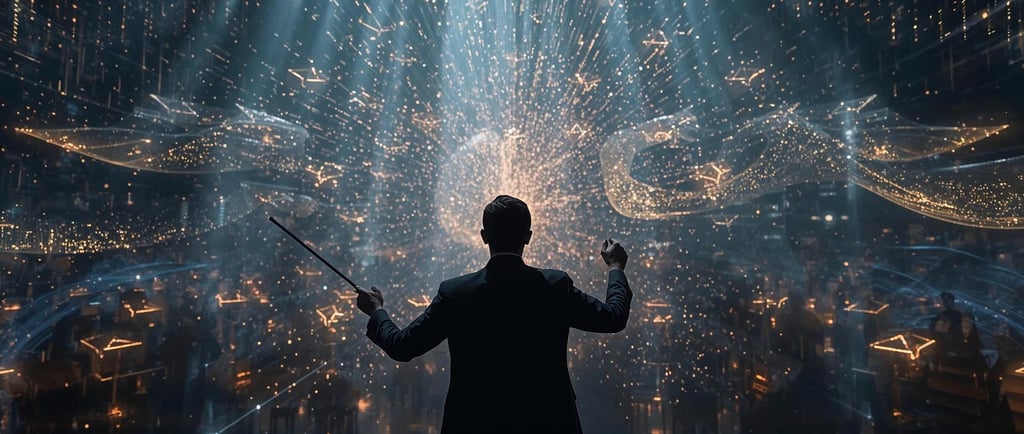
The marketing leader of the future is not a funnel manager; they are an Augmented Marketer. They are not a mechanic tuning an engine; they are a conductor leading a symphony orchestra. Their job is not to manage a linear process, but to harmonize a complex, intelligent, and responsive ecosystem.
The Three Pillars of the Augmented Marketer
To make this shift from funnel manager to ecosystem conductor, marketers must embrace three new disciplines. These are the pillars of the Augmented Marketer.
1. From Campaign-Centric to Customer-Centric Orchestration
The old way was to plan and execute campaigns. "Q3 Email Campaign." "Holiday Push." "New Product Launch." These are discrete, project-based efforts. The new way is to orchestrate a continuous, personalized customer experience.
The Old Way (Campaign-Centric): A marketer plans a "Welcome Series" email campaign. The AI helps optimize send times and subject lines. The campaign runs, it's measured, and it ends.
The New Way (Customer-Centric Orchestration): A marketer defines a goal: "Ensure every new customer feels valued and understands our core value within the first 7 days." The AI then builds a dynamic, multi-channel "journey" in real-time. For one customer, this might be a welcome email, followed by a targeted Instagram story, then a push notification with a tutorial video when they open the app. For another, it might be a series of SMS messages and an invitation to a webinar. The AI adapts the sequence, channel, and content based on the individual's behavior in real-time. The marketer's role is not to build the campaign, but to define the principles of the experience and provide the AI with the creative assets to deploy.
2. From Reactive Analytics to Predictive Symphony
For years, marketing analytics has been a rearview mirror. We analyze what happened last quarter to inform what we do next quarter. We are constantly reacting to past data. AI allows us to flip the mirror into a windshield.
The Old Way (Reactive Analytics): A marketer looks at last month's data and sees that cart abandonment is high. They hypothesize why and run an A/B test on the checkout page next month.
The New Way (Predictive Symphony): An AI is constantly monitoring real-time behavioral data across all channels. It identifies a micro-segment of users who are exhibiting subtle signals of "purchase hesitation"—perhaps they've visited the pricing page three times but haven't clicked "buy." The AI doesn't just flag this; it proactively generates and deploys a targeted intervention. It might be a limited-time, 10% discount code pushed via browser notification, or an email that pops up with a customer testimonial. The marketer doesn't have to wait for the problem to become a statistic; they are empowered to solve it at the moment of inception. The AI is not just reporting the music; it's composing new notes to keep the symphony harmonious.
3. From Brand Storytelling to Generative Reality
Brand storytelling has been the holy grail of marketing. We craft a narrative and push it out to the world. But in an age of hyper-personalization and AI, a single, static story is no longer enough. The future is Generative Reality.
The Old Way (Brand Storytelling): A car company creates a beautiful commercial about "freedom" and "adventure" and runs it on TV and YouTube. Everyone sees the same story.
The New Way (Generative Reality): A car company uses generative AI to create a unique story for every single user. A young professional in a city sees an ad about the car's seamless parking-assist feature helping them navigate a busy day. A family in the suburbs sees a different ad about the spacious interior and safety ratings on a weekend road trip. An outdoor enthusiast sees a third ad about the vehicle's off-road capability. The AI doesn't just swap out the background; it regenerates the core narrative, the music, and the pacing to resonate with the specific psychographic profile of the individual. The brand is no longer telling a story; it is generating a personalized reality for each customer, built on the foundational truth of the brand.
The Role of the Augmented Marketer: The Conductor
In this new paradigm, the marketer's role is elevated. They are no longer a tactician; they are a strategist, a creative director, and an ethicist all in one.
As the Visionary: They define the core brand promise and the principles of the customer experience. They set the tempo and the key for the symphony.
As the Creative Director: They provide the AI with the high-quality creative building blocks—the brand voice, the core messaging, the visual assets, the ethical guidelines. They don't generate every ad, but they curate the palette from which the AI creates.
As the Ethicist: They establish the guardrails. They are responsible for ensuring that the AI's hyper-personalization doesn't become creepy or discriminatory. They ask the hard questions: "Are we using this data responsibly? Are we enhancing the customer's life or just manipulating them more effectively?"
Conclusion: The End of the Funnel, The Rise of the Ecosystem
The marketing funnel is a relic of a simpler time. It served us well, but it can no longer contain the complexity of the modern customer or the power of artificial intelligence.
The future belongs to the Augmented Marketer. They understand that their job is not to control the customer but to create an environment where the customer can thrive. They conduct a symphony of intelligent experiences that are personalized, predictive, and profoundly human. They use AI not to replace creativity, but to amplify it, to create a one-to-one relationship with every single customer, at scale.
The age of the funnel is over. The age of the ecosystem is here. It's time to pick up the baton.
The funnel is over. The future is symphonic.