
The Architecture of Serendipity: Engineering Environments for Unplanned Genius
Yaz Gilbert
11/6/20256 min read
In 1968, a 3M scientist named Dr. Spencer Silver was trying to create a super-strong adhesive. He failed. Miserably. What he created instead was a weak, low-tact, acrylic pressure-sensitive adhesive that could be stuck to surfaces and removed easily without leaving a residue. For five years, it was a solution without a problem—a brilliant failure sitting in a lab notebook. Then, another 3M scientist, Art Fry, was getting frustrated. The bookmarks he used in his church hymnal kept falling out. He remembered Silver's "failed" glue and had an idea. The Post-it Note was born. A multi-billion dollar product, born not from a plan, but from an unexpected collision between a forgotten failure and a personal frustration.
This story is not an anomaly. It is a window into a fundamental truth we have engineered out of our modern existence. We have an obsession with efficiency. We design our organizations, our cities, and our lives to eliminate friction, streamline processes, and optimize for predictable outcomes. We build assembly lines for products, and we have unwittingly built assembly lines for ideas. We schedule back-to-back meetings, create siloed departments, and design workflows that are brilliant at executing the known, but profoundly terrible at discovering the unknown.
In our relentless pursuit of efficiency, we have engineered serendipity out of existence. We have forgotten that the most breakthrough innovations, the most transformative partnerships, and the most elegant solutions rarely come from a planned agenda. They emerge from the unexpected collision—the chance encounter in the hallway, the overheard conversation at a neighboring table, the discovery of a seemingly irrelevant piece of information that unlocks a stubborn problem.
Serendipity is not magic. It is not luck. It is an emergent property of a specific type of environment. And if it is an emergent property, it can be engineered. This is the practice of Architecture of Serendipity—the deliberate design of systems, spaces, and cultures that increase the probability of valuable, unexpected collisions.
The Four Pillars of Serendipitous Design
Just as a building requires a foundation, framing, and utilities, an environment that fosters serendipity is built on four essential pillars. Neglect any one of them, and the structure becomes unstable.
1. Controlled Entropy: The Beauty of Productive Messiness
The natural enemy of serendipity is over-optimization. A perfectly ordered system has no room for the unexpected. Controlled entropy is the principle of introducing just the right amount of "messiness" into a system to allow for novel connections to form.
The Error: We create hyper-efficient, siloed workflows where a marketing person never talks to an engineer, and an accountant never interacts with a designer. We believe this prevents distraction.
The Principle: Innovation happens at the intersections. By deliberately creating "leaky" systems where information, people, and ideas can spill over from one domain to another, we create the conditions for interdisciplinary insight.
The Application: At an organizational level, this means creating shared physical spaces (a central café, not a microwave room), mixed-team project "skunkworks," and cross-functional job rotations. At a digital level, it means using shared communication channels (like a well-moderated company-wide Slack) instead of exclusively siloed ones. The goal is to create a system where it is not only possible but probable that a biologist will stumble upon a marketer's problem and see it with fresh eyes.
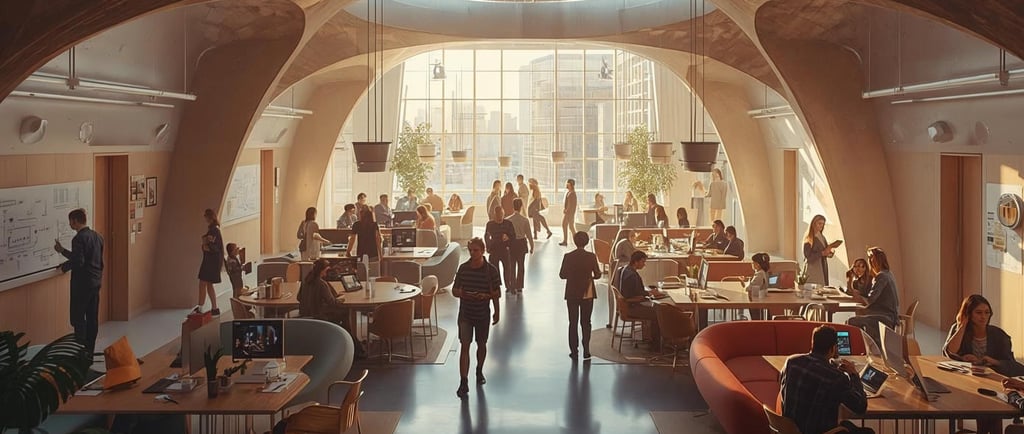
Case Study in Action: Google is famous for its office design, which prioritizes creating these "leaky" spaces. The central atriums, long lunch tables, and shared cafes are not perks; they are engineered environments designed to force engineers and salespeople, who might otherwise never interact, to bump into each other and have an unplanned conversation.
2. Cognitive Diversity: The Power of Dissimilar Minds
Serendipity thrives on difference. If everyone in a room thinks the same way, has the same background, and uses the same mental models, the probability of a truly novel idea emerging is near zero. They will only iterate on what they already know.
The Error: We hire for "culture fit," which often becomes a proxy for hiring people who look, think, and act just like us. We build homogenous teams and are then surprised when they produce homogenous ideas.
The Principle: The most innovative teams are not collections of like-minded experts; they are diverse cognitive ecosystems. They bring together different ways of thinking—the engineer's systems logic, the artist's aesthetic intuition, the historian's long-view perspective, the anthropologist's deep empathy.
The Application: Actively hire for "cognitive friction." Build teams with a diversity of academic backgrounds, life experiences, and problem-solving approaches. When forming a group to tackle a problem, intentionally invite at least one person from a completely unrelated discipline. Their job is not to provide the answer, but to ask the questions no one else is thinking to ask.
Case Study in Action: A medical device company I advised was struggling to improve the ergonomic design of a new surgical tool. Their team of brilliant engineers had hit a wall. On a hunch, they brought in a concert pianist for a single design session. Her focus on "feel," "touch," and "subtle hand movements" provided a vocabulary and perspective the engineers lacked. Her input led to a breakthrough in the handle's design that made the instrument significantly more intuitive for surgeons to use.
3. Asynchronous Overlap: Designing Time for Collision
The modern workplace is a disaster for serendipity. We have replaced the organic, asynchronous rhythms of a physical office with the rigid, synchronous tyranny of the video call. There is no "in-between" time—no walk from the meeting room to the desk, no waiting for the coffee to brew—where a casual, unplanned interaction can occur.
The Error: We schedule every minute of the day, believing that productivity is a function of time-on-task. We eliminate "unproductive" downtime.
The Principle: Serendipity needs temporal space to emerge. It requires overlaps in the schedules and physical locations of people, where they are free to engage without a pre-defined agenda.
The Application: In a remote or hybrid world, this is a design challenge. Create "virtual co-working" sessions where team members are on a call together, not talking, just working in companionable silence, available for a quick question. Design office schedules so that teams are encouraged to be in the same physical space on the same days. Institute "meeting-free" afternoons to allow for the spontaneous, informal interactions that fuel innovation.
Case Study in Action: Steve Jobs was a master architect of asynchronous overlap. When he designed the Pixar campus, he was obsessed with where people would physically intersect. He initially planned to have separate buildings for animators, coders, and storytellers. He famously scrapped the plan and designed a single, massive building with a central atrium, forcing everyone to bump into each other on their way to get mail or grab coffee. He believed those unplanned conversations were the lifeblood of the company's creativity.
4. Pattern Recognition Infrastructure: Making Sense of the Noise
An environment rich in entropy, diversity, and overlap will produce a massive amount of "noise"—countless random data points and connections. Without a way to recognize the valuable signal within that noise, it's just chaos.
The Error: We are so focused on generating ideas that we have no system for capturing, connecting, and evaluating the unexpected ones that arise.
The Principle: Serendipity requires a mechanism for pattern recognition. It needs a system for seeing the threads that connect disparate events and ideas.
The Application: This can be low-tech or high-tech. It can be a physical "idea wall" where anyone can post a random thought, news article, or sketch. It can be a digital tool like a shared Miro board or a company-wide channel for posting "interesting but irrelevant" links. The key is to create a visible, persistent repository where these random sparks can land and be seen by others, allowing the human brain's natural pattern-matching ability to work its magic.
Case Study in Action: An advertising agency I worked with implemented a "Serendipity Board" in their main hallway. It was a massive corkboard where anyone could pin a news article, a photo, a competitor's ad, or a random sketch. There was no rule or agenda. Once a quarter, the leadership team would spend an hour reviewing the board. On more than one occasion, they spotted emerging trends and connected disparate ideas that led directly to successful new client pitches.
The Serendipity Audit: A Practical Framework
How do you know if your environment is serendipity-friendly? Conduct a quarterly audit using these four questions:
Controlled Entropy: "Where are the 'leaky' places in our organization where information and people from different departments can spontaneously mix? If we can't name three, we are too siloed."
Cognitive Diversity: "Looking at our last three key project teams, what was the true diversity of thought and background? If everyone has the same degree or professional title, we are too homogenous."
Asynchronous Overlap: "How much of our team's week is unscheduled and allows for informal, in-person or virtual interaction? If it's less than 10%, we are too rigid."
Pattern Recognition Infrastructure: "What is our central, visible system for capturing and connecting random ideas and insights? If it's just email inboxes, we are losing our sparks."
Conclusion: From an Architecture of Efficiency to an Architecture of Discovery
The 20th century was about building an architecture of efficiency. The 21st century will be about building an architecture of discovery. The challenges we face—from climate change to geopolitical instability to the future of work—are too complex to be solved by the same minds using the same processes in a sterile, optimized environment.
We must become architects of serendipity. We must design our companies, our technologies, and our cities not just for productivity, but for possibility. We must intentionally introduce a little productive messiness, seek out cognitive friction, protect time for idle overlap, and build systems to help us see the patterns in the chaos.
The next great breakthrough will not come from a meticulously planned brainstorming session. It will come from an unexpected collision in a space you had the wisdom to design. Stop trying to eliminate the noise. Start building the listening posts.